FinOps in one definition
The FinOps Foundation defines FinOps as “an operational framework and cultural practice which maximizes the business value of technology”. The word joins Finance and DevOps. It names a way of working. It is neither a job title nor a tool.
The Foundation is clear that FinOps goes beyond saving money. A company may tighten spending one year and invest more the next. What matters is that teams can weigh speed, cost and quality with data they trust and with clear ownership.
FinOps grew up with the public cloud. The Foundation now applies it to all technology spend, including SaaS, licensing and data centers. Its framework names personas from engineering and finance to product, procurement and executives.
The six principles
The framework rests on six principles. Here they are in plain words:
- Teams work together: engineering, finance and the business use the same numbers.
- Business value guides decisions. A rising bill can be good news.
- Everyone answers for their usage: whoever runs a service owns what it costs.
- Cost data stays easy to reach, recent and correct.
- A central team equips the practice, sets standards and helps the others.
- Teams use the variable cost of the cloud to their advantage.
Inform, Optimize, Operate
The 2026 framework groups its capabilities into four domains: understand usage and cost, quantify business value, optimize usage and cost, and manage the FinOps practice. It also defines scopes, which are segments of technology spend such as a product or a cost center. The Crawl, Walk, Run approach tells you to start small and grow as the value justifies it.
The work itself follows three phases, in a loop:
- Inform: understand cost, usage and efficiency, and link them to owners.
- Optimize: find improvements, both in what you use and in what you pay for it.
- Operate: apply the changes, then start the cycle again.
Why Kubernetes makes FinOps harder
A cloud bill lists machines. Kubernetes shares those machines between many teams. The Foundation’s working group on containers makes the point: a container has no direct cost, and nothing maps a charge line to a workload in a simple way. Allocation therefore needs a rule.
You also need to decide who carries idle capacity and shared costs. The working group lists management nodes, cluster state stores, licenses, backups and disaster recovery among them. Namespaces and labels carry the link to teams, cost centers, applications and environments.
The first choice is the basis of the split:
- Requests: every cost of the cluster finds an owner, and teams have a reason to ask only for what they need. The risk is requests set too low, or missing.
- Real usage: each team pays for what it consumes. Someone still has to pay for idle time, and teams can reserve extra capacity without carrying its cost.
Start with one cluster
You do not need a FinOps team to begin. One scope is enough for a first loop.
Work on usage before rates. Oversized requests, idle workloads and environments left on at night come before commitments, or you lock in waste. Track a unit cost as soon as you can, such as a cost per customer.
A first loop looks like this:
- Pick one scope: a product or a production cluster.
- Name an owner for each namespace and add the missing labels.
- Agree on the allocation rule with finance and write it down.
- Review a few costs with engineers at a fixed rhythm.
- Choose one action, note the expected result and check it afterwards.
What Onicost brings to this loop
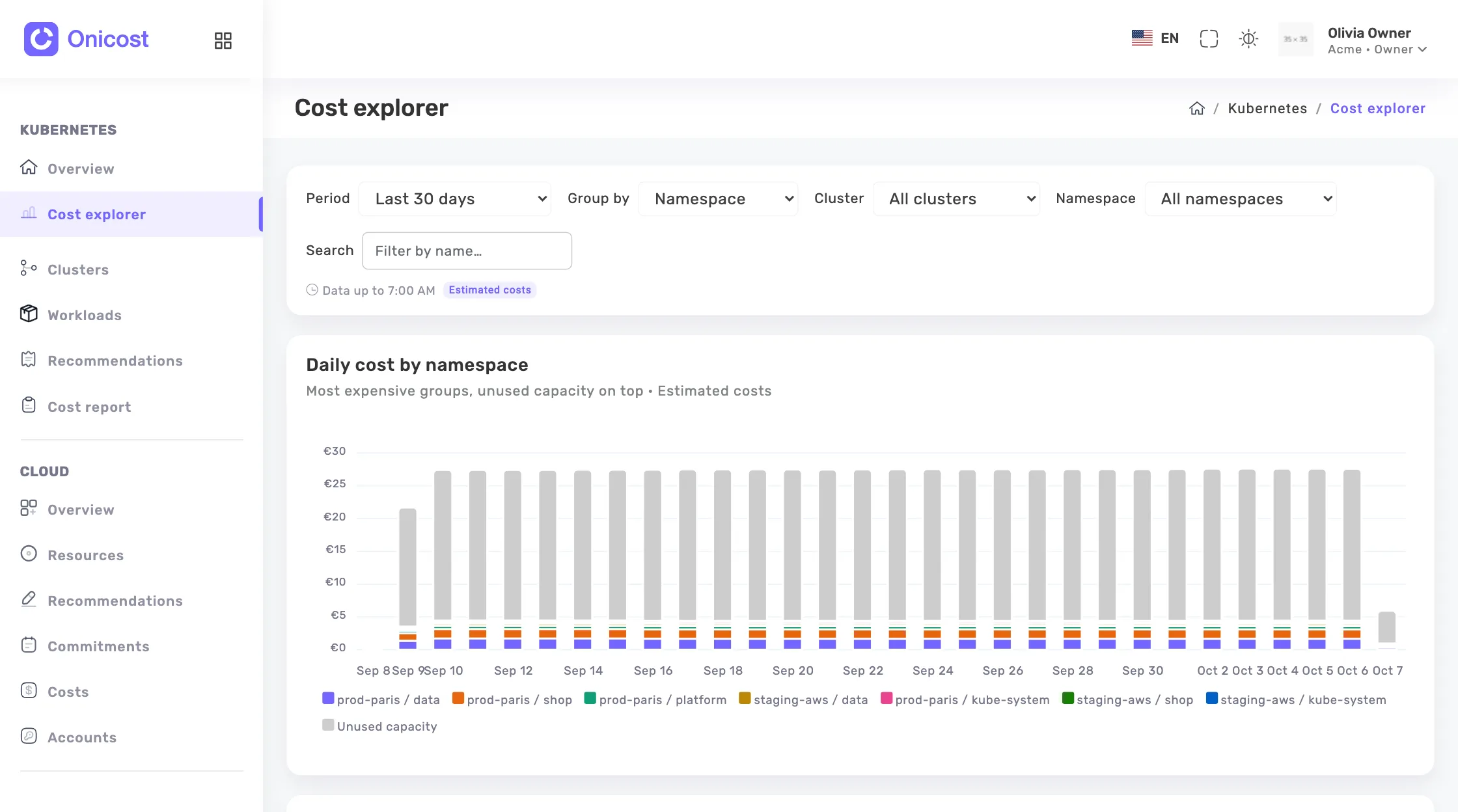
Onicost covers Kubernetes and the cloud in two separate spaces. For Inform, it shows estimated costs per cluster, node, namespace, workload and label. It separates what runs your applications, what supports the system and what stays unused. Prices come from the public rates of AWS, Azure, Google Cloud, OVHcloud and Scaleway, or from your own rates for on-premises nodes.
For Optimize, recommendations cover requests, nodes, health and waste, with estimated savings and no guarantee. The Cloud workspace proposes commitments. For Operate, the scheduler stops environments on your calendar, and CSV exports and PDF reports feed your reviews. Your team applies the recommendations through its own tools.
Data stays in France, with Scaleway, in the Paris region, for 13 months. Free covers 1 cluster, 32 cores and 2 members. Team starts at €39 per month before tax and Business at €99 per month before tax, with a 14-day Team trial and no card.
Frequently asked questions
Is FinOps only about cutting costs?
No. The FinOps Foundation presents it as a way to get more value from technology. Depending on the period, that leads to spending less or to investing more.
Do you need a dedicated FinOps team?
Not at first. The Foundation describes a central group that supports the practice while each team owns its usage. In a small company, one person can hold that role part-time.
What is the difference between FinOps and DevOps?
DevOps brings development and operations together. FinOps adds finance and the business to that conversation, around cost and value.
How do I split a cluster’s cost between teams?
Choose a basis, requests or real usage, then a rule for idle capacity and shared costs. Start simple and write the rule down before you compare teams.